
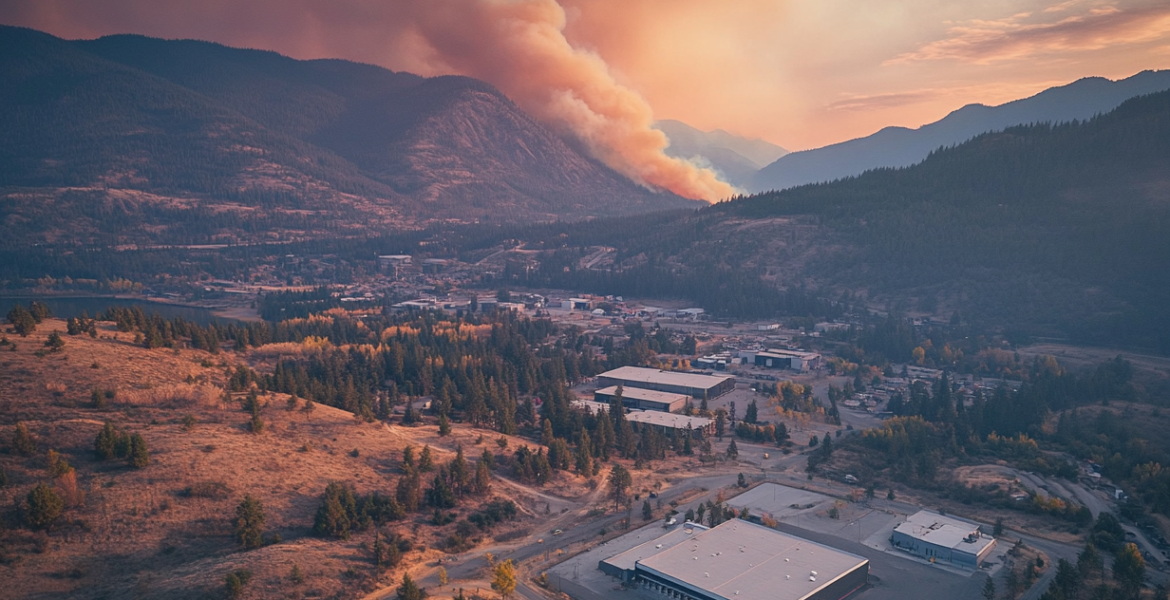
Quick Answer: British Columbia is forecast to face the highest and most sustained wildfire risk of any Canadian province in 2026, peaking in July. The BC Interior entered the season with record-low valley-bottom snowpack, multi-year drought in the Northeast and Chilcotin, and elevated Drought Code values. Across the border, eight U.S. states set new April 1 snowpack lows and the season is already well past the 10-year average for acres burned. For industrial operators, camp managers, municipalities, and resort properties across BC and Western Canada, peak season is open.
The 2026 wildfire season outlook for BC and Western Canada is serious. Natural Resources Canada’s modelling confirms BC faces the highest and most sustained fire danger of any Canadian province through July, and the spring precipitation window that could have shifted that trajectory has closed. Eight western U.S. states set new April 1 snowpack records according to NIDIS, and the U.S. has already recorded over 2.5 million acres burned as of mid-June according to NIFC, nearly double the 10-year average.
This post walks through what the current conditions actually show, what federal and provincial forecasters are saying, and what it means for sites across BC and Western Canada as the peak window opens.
Educational summary based on official outlooks from the BC Wildfire Service, Natural Resources Canada, CIFFC, NIFC, and NIDIS. For operational decisions, follow your local fire authority.
What BC Wildfire Service Is Saying for 2026
The BC Wildfire Service’s Spring 2026 Seasonal Outlook identifies several areas of elevated concern heading into summer:
- The northeast region is the highest-concern area in BC, carrying multi-year drought conditions that even above-average 2025 summer rainfall couldn’t resolve.
- The Kamloops Fire Centre and western Cariboo (Chilcotin) are carrying moderate drought and elevated Drought Code values — meaning deep organic layers are dry enough to sustain smoldering and support large fire behaviour even with normal precipitation.
- Interior valleys are seeing record-low valley-bottom snowpack due to higher-than-normal winter freezing levels, specifically increasing the likelihood of early-season grass fires in the Thompson, Okanagan, and Nicola regions.
- Season severity was forecast to depend heavily on May and June precipitation. That window has now passed. Areas carrying elevated Drought Code values heading into spring — particularly the Northeast, the Chilcotin, and the South Thompson — will carry those conditions into the peak July fire window without the reset a wet spring would have provided.
The same federal outlook confirmed above-normal temperatures for nearly all of Canada through June, July, and August, with BC carrying the highest and most sustained fire risk of any province.
Snowpack and Drought: The Fuel Conditions Heading In
BC’s Interior snowpack entered the season at record-low levels at valley bottoms, with the Interior at a 40-year low — the BCWS seasonal outlook notes this directly increases the likelihood of early-season grass fires in Interior valleys. The Canadian Drought Monitor shows severe drought pockets across the southern BC Interior and prairies, with the Northeast BC drought being multi-year — meaning deep fuel moisture deficits that normal spring precipitation alone cannot fix.
South of the border, the April 2026 NIDIS snow drought update showed historically bad numbers: eight states set new April 1 snow water equivalent records, 64% of all SNOTEL monitoring sites tied or set new record lows, and a March heat wave melted out what remained weeks ahead of schedule. Nevada hit 13% of median peak SWE — the lowest on record. Wyoming, Utah, Colorado, and New Mexico set benchmarks with no comparable years in the SNOTEL record. The May NIDIS update confirmed that significant hydrological drought impacts are already occurring across much of the West and will continue through summer.
Mountain snowpack is the single best predictor of summer fire conditions in western North America. It acts as a natural reservoir keeping forest fuels wet into peak season. When it disappears weeks early — as it did across BC’s Interior and the western U.S. in 2026 — that buffer is gone before the hottest months arrive.
Drought compounds this further. The U.S. Drought Monitor shows continued widespread drought across the West heading into June. The March NIDIS update flagged that the Bureau of Reclamation’s most probable forecast shows Lake Powell potentially approaching minimum power pool elevation by December 2026 — a signal of how depleted the broader western system is heading into peak demand.
The Weather Pattern Through Summer
The BC Wildfire Service notes that ENSO has transitioned from La Niña toward strong El Niño conditions expected to develop by June-July. BCWS is careful to note that the correlation between El Niño and BC fire activity specifically remains inconclusive — but the temperature picture is clearer. Forecasted temperature anomalies show above-normal readings across the BC Interior through July. The Climate Prediction Center puts the probability of El Niño developing by late spring at 60%, with above-normal temperatures favoured across the West through summer and below-normal precipitation expected for the Northwest and northern Rockies.
For BC, there is no monsoon offset equivalent to what parts of the U.S. Southwest might see. The spring precipitation window that could have moderated conditions has now closed. What remains is the summer weather pattern — and the current signals point consistently toward heat and dryness across the Interior.
Regional Outlook: Where Risk Is Highest
BC Interior — Kamloops, Thompson, Okanagan, Cariboo
This corridor is carrying the highest combination of risk factors in the province heading into summer: elevated Drought Code values, record-low valley snowpack, and above-normal temperatures forecast through July. It is also BC’s most historically active fire region — the 2021 Lytton fire in the Thompson Canyon and the 2023 McDougall Creek fire near West Kelowna both burned within this corridor, and both arrived faster than most affected communities and operators had planned for. Peak season is now open across this region.
BC Northeast — Fort St. John, Fort Nelson, Peace Country
The northeast is entering the season carrying multi-year drought conditions that last summer’s above-average rainfall couldn’t fully resolve. Deep fuel moisture deficits in duff and organic layers don’t recover in a single season, and the federal outlook identifies this corridor as part of BC’s sustained high-risk zone through July. Remote industrial sites and camps in this region face an elevated-risk window with less margin for error than a typical year.
Northern Rockies and U.S. Pacific Northwest
Above-normal significant fire potential is forecast for July and August across the Idaho Panhandle and Nez Perce-Bitterroot National Forests — weather patterns that don’t stop at the border and are directly relevant to conditions in southern Alberta and southeastern BC. The U.S. season is already well underway: NIFC reports over 2.5 million acres burned as of mid-June. A resource-intensive season south of the border also reduces the cross-border mutual aid available to Canadian fire operations during simultaneous events.
What Operators and Communities Should Be Doing Now
Peak season is open across the BC Interior. For industrial sites, remote camps, oil and gas operators, resort properties, and municipalities across BC and Western Canada, the window for deliberate preparation is closing — but there is still meaningful action available before the highest-risk weeks of July arrive.
- Commission a site risk assessment. A wildfire consulting assessment now identifies your highest-exposure structures, water supply constraints, and defensible space gaps. SPIEDR’s consulting team works across BC with industrial operators, municipalities, and land developers in the fire centres BCWS has flagged as elevated-risk this season.
- Verify water supply and equipment readiness. Confirm on-site water sources are accessible, pumps are serviced, and hose lines and fittings are staged for rapid deployment. If your site has grown since your last protection plan was reviewed, coverage should be reassessed. SPIEDR’s structural protection units and sprinkler trailers are designed for rapid deployment — but they need to be on-site before a fire starts nearby.
- Train crews now. Wildfire fighting training before July means your crews aren’t learning equipment operation under smoke. FireSmart-aligned certified programs are available across BC. Always remember to rely on fire fighting professionals where possible, and prioritize your own health and safety first.
- Confirm evacuation and communication protocols. Remote sites with limited egress need pre-agreed muster points and clear authority-to-evacuate procedures. In BC interior fires, road access can close within hours.
A Note for Residential and Lakefront Property Owners
SPIEDR’s equipment is designed primarily for commercial and community-scale protection, but residential property owners in BC’s interface zones — particularly lakefront properties, rural acreages, and homes in communities with long fire response times — can also use structure protection systems. SPIEDR’s wildland sprinkler kits are designed for residential and small-property deployment. The same principle applies: installed and tested before fire season, not during an active event. BC’s FireSmart program provides a property-level defensible space checklist for homeowners.
The Bottom Line
BC is forecast to carry the highest and most sustained wildfire risk in Canada this summer. The spring precipitation window that could have moderated the outlook has closed. Multi-year drought in the Northeast, record-low Interior snowpack, elevated Drought Code in the Kamloops and Cariboo Fire Centres, and above-normal temperatures forecast through July are consistent across federal, provincial, and continental forecasting sources.
The primary variable remaining is summer weather — a cooler, wetter July would reduce but not eliminate risk in affected regions. Watch the BC Wildfire Service for current fire status and any new restrictions or bans across the province.
BC is forecast to face the highest and most sustained fire danger of any Canadian province in 2026, peaking in July. The Interior entered the season with a 40-year low in valley-bottom snowpack and multi-year drought in the Northeast and Chilcotin. The spring precipitation window that could have moderated conditions has now closed without sufficient recovery in the most at-risk fire centres.
Snowpack releases meltwater through spring and early summer, keeping forest fuels wet well into fire season. When it melts out weeks early — as it did across BC’s Interior and the western U.S. in 2026 — fuels dry ahead of schedule, the fire-receptive window opens earlier, and high-elevation fuels that normally stay damp into July become available during peak season.
Drought dries out deep organic layers — duff, fallen timber, root systems — that surface moisture alone doesn’t reach. High Drought Code values, which BC is carrying in several fire centres this year, mean fires burn hotter, spread faster, and are harder to suppress even when surface conditions look manageable.
Ideally, the four to six weeks before peak season opens — typically May through mid-June for the BC Interior. That window has now passed for 2026. Preparation completed before July still offers meaningful protection, but the margin for deliberate planning is narrowing as the highest-risk weeks approach.
Commercial systems are designed to defend multiple structures simultaneously at scale — a single structural protection unit can cover up to 50 buildings and is built for industrial water volumes and rapid crew deployment. Residential wildland sprinkler kits are designed for single-property deployment, protecting a home or small acreage. Both are most effective when installed and tested before a fire is in the area.

