
Wildfire Protection for Critical Infrastructure in BC: Utilities, Water Systems, and Oil & Gas Sites
|
Quick Answer: Wildfire protection for critical infrastructure in BC now includes transmission-line hardening and vegetation management at BC Hydro, SCADA and backup-power upgrades at municipal water plants, and site-level emergency-plan reviews directed by the BC Energy Regulator. On-site structure protection — sprinkler perimeters, pre-staged trailers, and deployment-ready crews — sits alongside these measures to defend the buildings and yards housing the equipment itself. |
Two recent BC wildfire seasons made the operational case clear: critical infrastructure doesn’t just lose power during a fire — it loses structures, control systems, and years of recovery time. BC Hydro replaced roughly 200 transmission structures and over 1,200 distribution poles after the 2023 season. The 2021 Lytton fire destroyed 90 per cent of the village within hours, took out the electrical infrastructure entirely, and left the wastewater treatment plant requiring more than $7.5 million in joint federal, provincial, and municipal rebuild funding — announced in December 2025. For utilities, water authorities, oil and gas operators, and municipalities running essential services, wildfire protection is no longer a seasonal precaution. It is part of asset management.
This post covers what BC operators are already doing at the system level, and where site-by-site structure protection fits in.
How Wildfires Damage BC Critical Infrastructure: Three Patterns Operators Need to Know
A wildfire near a transmission corridor, a water treatment plant, or a compressor station causes damage well beyond the immediate burn perimeter. Three patterns repeat across recent BC seasons.
Structures burn first; recovery takes years.
The Lytton wastewater treatment plant sustained damage in 2021 that has taken years to address. Even when core process equipment survives, ancillary structures — pump houses, control buildings, fuel storage — often don’t, and replacing them runs on multi-year timelines.
Outages extend far beyond the fire perimeter.
Smoke and ash settling on high-voltage conductors and insulators reduce electrical performance and raise the risk of arc faults, flashovers, and automatic line trips. A water utility 200 km from the active fire can still lose grid reliability for weeks.
Repair costs scale fast.
BC Hydro reported approximately $15 million in response and repair costs from 2024 alone, after losing 57 transmission structures and 53 distribution poles. The 2023 season was substantially more destructive.
For infrastructure operators, this reframes the planning question. It’s not whether wildfire affects operations — it’s how long operations stay down and how much of the recovery budget goes toward rebuilding versus running.
What BC Utilities and Regulators Are Doing in 2025–2026
The system-level response in BC has moved faster than most other sectors.
BC Hydro’s Wildfire Hardening Program for Transmission and Distribution
BC Hydro is layering several measures across its transmission and distribution network. Fire-resistant pole wraps — steel mesh coated with a heat-activated barrier — are being installed on wood structures to shield them from radiant heat and direct flame while allowing moisture to escape and prevent decay. By mid-2024, the utility had installed wraps on roughly 1,000 structures along the Fort Nelson-to-Alberta-border transmission line and on sections of the West Kelowna line. When replacing damaged or aging wood poles, BC Hydro now uses fibre-reinforced polymer poles, which are non-combustible.
The utility also operates lines in “no reclose mode” during periods of elevated fire risk — meaning that when a fault occurs, the line won’t automatically re-energize, which reduces the chance of sparks or ignition from equipment contact. Vegetation on and near electrical rights-of-way is assessed and managed annually to reduce fuel loading.
Water and Wastewater System Upgrades After the 2021 Lytton Fire
After Lytton, federal, provincial, and municipal governments committed over $7.5 million to rehabilitate the village’s wastewater treatment plant. The upgrades include new treatment components, a SCADA system for improved monitoring and process control, and a backup power supply — the kinds of redundancy that allow an operator to keep a plant running, or restart it faster, when surrounding infrastructure is compromised. This pattern is becoming standard for water utilities reviewing their own resilience: backup power, hardened control rooms, and remote monitoring that doesn’t depend on a single staffed building.
BC Energy Regulator’s Wildfire Preparedness Requirements for Oil and Gas Sites
The BC Energy Regulator issued a safety advisory in 2025 recommending that energy companies review their emergency management plans for wildfire preparedness, identify gaps in planning, and improve site-level readiness. The advisory explicitly calls out reviewing where structural protection units (SPUs) may be needed and ensuring sufficient on-site water supplies for at least 24 hours of structural protection. For oil and gas operations with remote camps, gas plants, compressor stations, and tank farms across the BC interior, this means each site needs a wildfire response plan that can be activated locally — including pre-staged equipment, trained operators, and identified water sources.
Where the Wildfire Protection Gap Sits for BC Infrastructure Operators
Most critical infrastructure operators in BC have addressed two parts of the wildfire problem effectively: hardening the equipment itself (pole wraps, fibre poles, fire-resistant building materials) and improving system-wide situational awareness (camera networks, predictive tools, communications with BCWS). The gap is the third part — active perimeter defence of the structures and yards that house the equipment.
A few examples of what that gap looks like in practice:
- Substations and switchyards with fire-resistant fencing but no water source on site to wet down vegetation around the perimeter as a fire approaches.
- Water and wastewater plants with hardened control rooms but no plan to suppress the fuel load on adjacent slopes ahead of an advancing fire front.
- Telecom huts and microwave relay sites sited on ridges for line-of-sight, often in heavily fuel-loaded terrain, with no on-site structure protection capacity.
- Oil and gas camps and gas plants with strong personnel evacuation plans but limited ability to protect uninhabited infrastructure once the camp is clear.
This is the layer where pre-staged sprinkler systems and structure protection units do their work. The principle behind SPIEDR’s WET FUEL WON’T BURN™ approach is straightforward: saturated vegetation and saturated structures do not ignite from radiant heat or ember showers the way dry ones do. A sprinkler perimeter running on a substation, plant, or camp ahead of a fire front does what a hardening program cannot — it changes the fuel itself.
Five Steps to a Wildfire Structure Protection Plan for BC Infrastructure Sites
For an operator running one or many critical infrastructure sites in BC, the structure-protection layer typically covers five areas.
- Asset triage. Not every structure warrants the same level of investment. The highest-priority assets are those whose loss creates the longest recovery tail — control rooms, switchgear, treatment process buildings, fuel storage, and any structure housing equipment with multi-month or multi-year lead times for replacement.
- Water source mapping. A protection plan needs a reliable draw point. Plants with treated or raw water supply, sites near rivers or lakes, and operations with on-site reservoirs are well positioned. Remote sites without a ready source need a plan that accounts for tanker or bladder support.
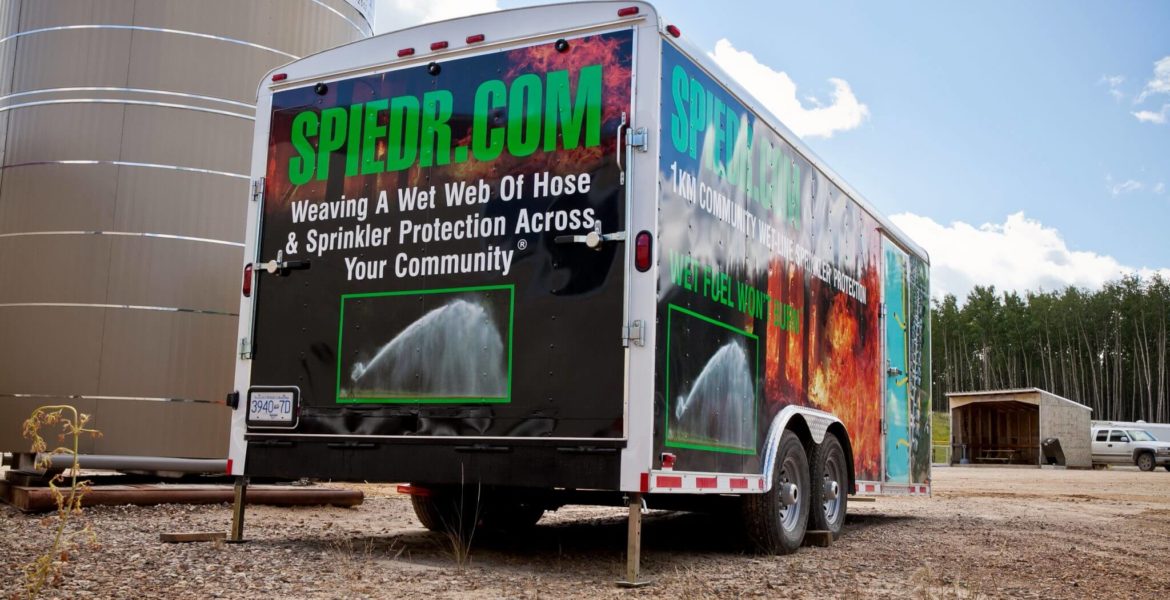
- Equipment pre-positioning. A structure protection trailer staged on site means the equipment is already there when warning comes. Equipment that needs to be trucked in during an active fire event often doesn’t arrive in time.
- Deployment training. Whoever is on site when the warning comes needs to be able to deploy the equipment. For utilities and water authorities, that’s often an operations or maintenance crew — not a dedicated fire response team. SPIEDR’s wildfire consulting work with commercial operators routinely includes deployment training for the people actually stationed on site. Formal wildfire fighting training is also available for crews who want a higher level of preparation.
- Annual drill and inspection. Equipment that sits idle for years between events fails when needed. A pre-season check and a deployment drill — typically in March or April, before BCWS resources are stretched — keeps gear ready when the season arrives.
How to Start: Wildfire Site Assessments for BC Infrastructure Operators
If you operate critical infrastructure in BC and your wildfire preparedness review hasn’t covered active perimeter protection, the entry point is a site assessment. SPIEDR works with utility operators, water authorities, industrial sites, oil and gas camps, and municipalities to identify which structures most need defence, where water comes from, what equipment fits the site, and who deploys it. That assessment doesn’t commit a site to a purchase — it produces the inventory and the plan, which the operator can phase against budget and risk priority.
The 2025 BCER advisory makes the regulatory direction plain: site-level preparedness is the standard. The structural hardening BC Hydro and others are doing covers the equipment itself. Active perimeter protection covers what hardening can’t — the structures, yards, and fuel loads immediately surrounding the asset.
Call SPIEDR at 604-812-3473 or contact us here to talk through what a site assessment covers.
WET FUEL WON’T BURN™ — and infrastructure that’s still standing after fire season is what keeps the lights on.
Frequently Asked Questions: Wildfire Protection for BC Critical Infrastructure
How much infrastructure damage have BC wildfires caused in recent years?
In 2023, BC Hydro replaced approximately 200 transmission structures and over 1,200 distribution poles. In 2024, the utility lost 57 transmission structures and 53 distribution poles, with response and repair costs of approximately $15 million. Smoke and ash damage to conductors and insulators creates additional reliability impacts not reflected in structure counts.
What is the difference between hardening infrastructure and wildfire sprinkler protection?
Hardening — pole wraps, fire-resistant materials, fibre poles — makes the equipment itself less likely to ignite or fail under radiant heat. Sprinkler-based structure protection changes the fuel around the equipment by saturating it before the fire arrives. They work together: hardening addresses failures it can reach, and active perimeter protection covers what hardening can't — particularly the buildings and yards housing the equipment.
Does SPIEDR work with utilities and government infrastructure operators?
SPIEDR's commercial work covers industrial sites, oil and gas operations, municipalities, resorts, wineries, and land developers, with wildfire consulting tailored to the specific site. The team is BC-based and works across Western Canada.
When should a BC infrastructure operator schedule a wildfire site assessment?
The strongest window is March through early May. Wildfire season in BC typically runs May through October, and once active, both BCWS resources and equipment providers are stretched. Site assessments, equipment purchases, and deployment training are best completed before the season starts.

